


Point (Fiona Payne): In “SAVE”ing America, our democracy is endangered
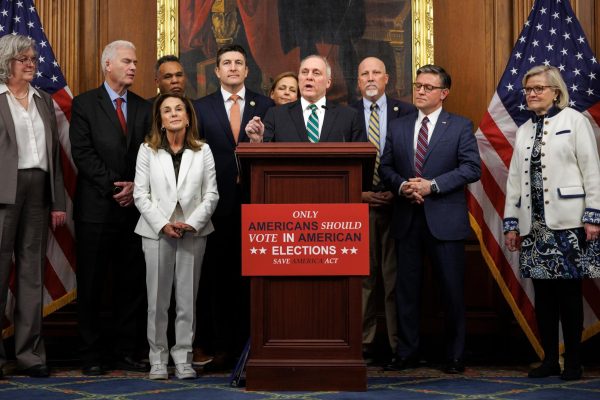
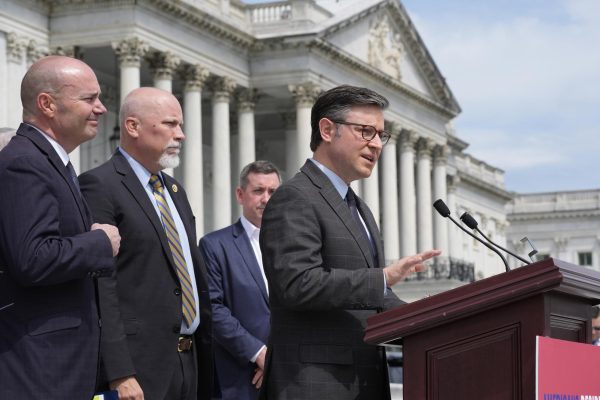
On February 11th, the Safeguard American Voter Eligibility, or SAVE Act, was passed in the House of Representatives by a vote of 218-213 and is awaiting further approval in the Senate. If passed, the bill would require Americans to provide documentary proof of United States citizenship and photo ID when registering for and casting a ballot in federal elections.
Acceptable documents include valid American passports, military identification cards, or federal, state, or Tribal government-issued photo ID accompanied by birth or naturalization certificates.
While unsuspecting voters may see this bill as a logical, if not already in place measure, there are many hidden downsides that have been left hardly addressed in national news. In actuality, the bill does nothing but disenfranchise legitimate voters.
A 2024 study conducted by the University of Maryland found that over seven million voting-age citizens have no form of non-expired government-issued photo identification. According to the Brennan Center for Justice, more than 21 million Americans—one in ten—lack ready access to their documentary proof of citizenship they would be required to present at polling places.
Moreover, the Brennan Center reports “at least 3.8 million don’t have these documents at all, often because they were lost, destroyed, or stolen,” as well as that while 28.6 million people have a non-expired license, it does not contain both their current name and address— which, by the regulations of the proposed bill, they would be mandated to update just to take advantage of their right to vote.
Not only are these processes lengthy, but an unnecessary expense that many in the depths of poverty may not be able to afford. This directly disenfranchises low-income voters, silencing the voices that often need to be heard most.
Some may suggest registering for a government-issued ID, but the same problem arises—you cannot receive one without proof of citizenship, like a birth certificate or passport. Additionally, a majority of states require proof of residency, which may be unattainable for already marginalized groups like the homeless.
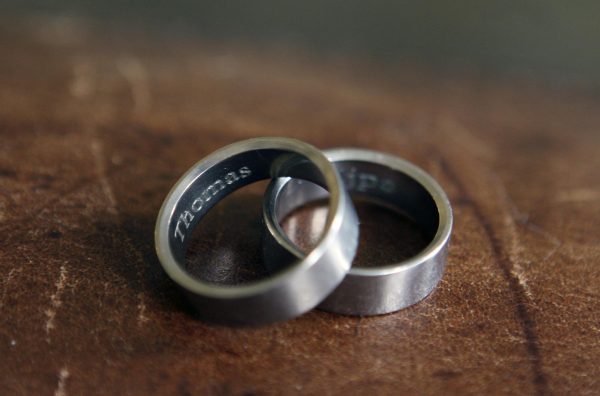
The implementation of this bill would widely cause complications for older, married or previously married women whose names do not match those on their identifying documents, putting tens of thousands of votes in jeopardy. In the United States, nearly 80% of women take their spouse’s surname, as reported by a 2023 study by Pew Research Center.
By the parameters of the SAVE Act, if a married woman has legally changed her last name to her spouse’s, but her only proof of citizenship is a birth certificate with her family name, she will barred from voting until the issue is rectified. However, even if one provides legal name change paperwork alongside a birth certificate to prove their identity, it is still not accepted as a recognized proof of citizenship under the SAVE Act.
This issue does not affect just women, but extends to anyone who has changed their surname.
Particulars of the bill claim that states must arrange processes for impacted parties to provide “such other evidence” of citizenship, but what these outlets may look like is masked with ambiguity and are nowhere outlined in its provisions. Directions as to how citizens can defend their rights are not indicated— a glaring issue that should raise anyone’s concern.
On numerous past occasions, these types of mandates have already proven harmful to the average voter.
In 2005 when a strikingly similar measure of requiring a birth certificate, passport, or naturalization papers to vote in Arizona was implemented, over 10,000 voters were prevented from voting in Maricopa County alone, as found by Ian Vandewalker, accredited senior counsel and manager in the Brennan Center’s Elections and Government program.
Chris Roads, chief deputy recorder and registrar at the time, stated, “The biggest bloc of people who are impacted are legitimate citizens,” explaining how upon technicality, they could not vote because they were unable to access the required documents. Another such incident took place in Alabama, where a minimum of 2,074 eligible voters had their registrations inactivated on the grounds that they were potential non-citizens, making up over half of the total flagged individuals.
Perhaps the most troubling fact of the matter is that the problem the bill claims to address is nonexistent—that is, these citizen sacrifices come with no true benefit to the country.
Experts at the Brennan Center for Justice found that, when surveying election officials across 42 jurisdictions, including those with high immigrant populations, suspected incidents of non-citizen voter fraud added up to 0.0001% in total.
Across a multitude of sources, including investigations performed by the Trump administration, this trend perseveres, with abysmally low or wholly absent rates. Statistically, it is more likely to be struck by lightning (~0.0009% according to the Center for Disease Control) than for a non-citizen to cast a ballot. The claim by politicians that it is “rampant” is undeniably false.
In addition, those wrongfully claiming to be a citizen when registering to vote already face felony charges, severe penalties for perjury, and can lose the ability to ever attain U.S. citizenship.
When considering the facts of the matter, it becomes overwhelmingly evident that the primary result of this bill is not “safeguarding” the American vote but straitjacketing it. More harm is inflicted on U.S. citizens than on the invisible assailant the SAVE Act claims to combat. Voting is the cornerstone of our democracy. Even the proposition of this bill bastardizes the precious birthright of all Americans and the very foundation of our nation. By building senseless barriers between everyday Americans and the supreme privilege of U.S. citizenship, the principle of free and fair elections for all is debased and endangered. We live in “the land of the free”—it is crucial that our elections stay that way too.
Counterpoint (Michala Holland): What’s wrong with “SAVE”ing America?
Another bill, another public outcry in America; it’s really nothing new.
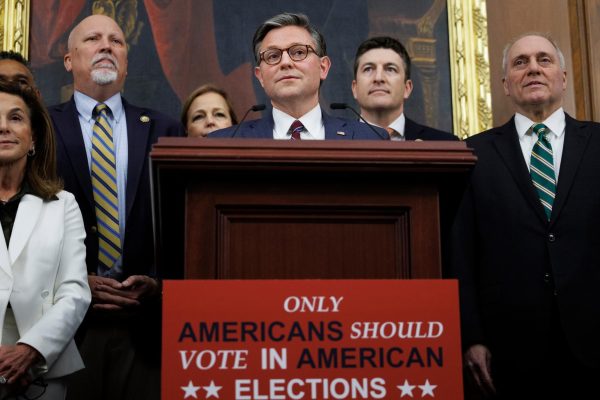
The Safeguard American Voter Eligibility Act, or the SAVE America Act for short, is a bill that would require those signing up for voter registration to show documents proving their U.S. citizenship.
Some types of documents that were listed are valid photo identification cards like driver licenses or military IDs, passports, birth certificates, an extract from a record of birth, and several other types of official documents, according to the H.R.22 SAVE Act document.
At its core, all this bill is doing is catch-up for everything else that requires IDs and documentation to prove who you are. To leave or enter America, you need proof of who you are; to buy alcohol, you need proof of your age; to drive, you need proof you can drive. The list goes on.
America has means of identification woven into our everyday lives, and the reason for this is nothing to scoff at either. The identification is to protect national security at airports, to prevent fraud at banks, to keep roads safer with licenses, and so on.
So, with this established in mind, why is this bill deemed to be so controversial when it’s only reasonable for IDs and documentation to prevent voter fraud? Well, this answer has less to do with the requirement itself and more to do with politics.
Even something as simple as cementing that American citizens are voting in federal elections is molded to be controversial due to x, y, and z in the political war climate the United States has become, just because President Donald Trump supported it. Although there are a few things that are good points to be made about this bill on the side of the opposition.
It is true that not every U.S. citizen has access to all their federal documents, as the Center for American Progress argues. It is also true that non-citizen voter fraud is rare. And it could put extra, unfunded work onto the state and election officials, who would have to verify everything in voting registration while at risk of fines as well as criminal charges for accidents, as the Brennan Center of Justice argues.
However, the extent of what is being argued is greatly exaggerated. This act would not suppress voters, as being a citizen of America is already a legal requirement to vote.
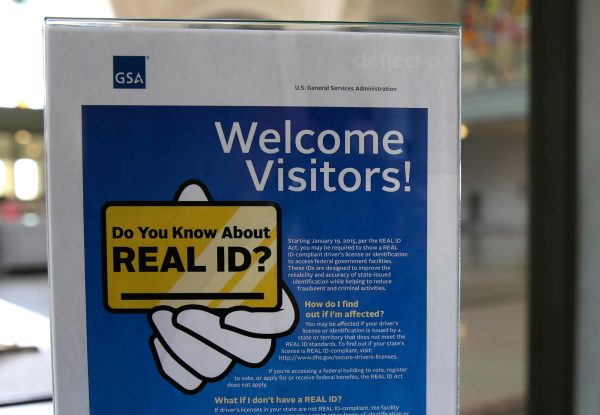
This also applies to married women or those who have legally changed their name, as all that is needed is the marriage license or federal documents indicating your name change from then to now. Which in the case of Florida, which uses REAL ID-compliant IDs, they are already accounted for with a little black star indicating it. All that is being asked for is proof upfront and, when implemented, the next step is to readjust systems to promote as much accessibility as possible.
Non-citizen voter fraud does not need to be frequent to warrant safeguards. Acts like this one exist to prevent even the possibility, rare as it may be. And while officials would gain more responsibilities, which most likely won’t be government-funded, could it reasonably be argued that America should have looser voting laws than banks, airports, or employers have?
Ultimately, the SAVE Act’s purpose is to modernize voting laws to the standard of verification expected in every citizen’s life. American citizens are not being barred from voting; that is beyond the point and purpose of its implementation. Overall, this act should not be discarded simply because some access issues need to be addressed.
The SAVE Act is not about limiting rights; it is about protecting them and safeguarding the credibility of every election.