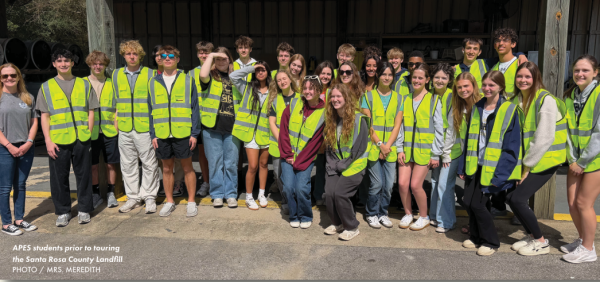


On February 26, Mrs. Meredith’s AP Environmental Science (APES) class had the opportunity to visit the Santa Rosa County Landfill. Students were able to conduct hands-on experiments and personally explore different sites within the landfill to better understand its’ systems and impact on the environment as it serves as a fundamental part of a city’s infrastructure.
Students learned that the facility is mainly separated into two classes. Class I consists of household waste that includes items such as food containers, residential garbage, and other waste materials from consumption of household products that make up most of the landfill’s waste. Class III items come from construction and demolition debris such as shingles and wood furniture. The landfill creates an open space called a cell where waste is disposed of and filled over a period of time; however, the rate at which each cell is filled can vary depending on certain environmental factors such as hurricanes or rainfall.
Additionally, the class visited the Household Hazardous Waste Center that offers citizens an environmentally safe way to dispose of materials, and even a way to reuse certain items like paint. At this site, select students participated in safely crushing lightbulbs with the Bulb Eater, as well as crushing aerosol cans.
Mrs. Meredith, who heads the fieldtrip, comments on how it came together, “This was our third time going to the landfill, and when I first started teaching APES I went to a workshop at a water treatment facility. I found it super interesting, and other teachers thought about visiting the landfill and talked about how it would be a good trip. I wanted students to think about where their garbage ended up, rather than just throwing it away without an idea of the whole process.”
Furthermore, she describes what she wanted her students to take away most from the trip, “I want them to have an understanding of their impact on the environment. By seeing the amount of trash that they generate and what it takes to be able to process that trash, to be able to contain it in a sanitary facility so that it doesn’t have impacts in terms of water pollution in our environment. Maybe, they’ll be able to see it and have a bigger appreciation for it and be more conscientious of their resources.”
Finally, she shares why it’s important for students to see environmental issues in real life, “Gulf Breeze is a small town. Sometimes we don’t recognize that something we do could have a far-reaching impact. I think it’s good to go outside city limits so that we can see different types of ecosystems and processes. We have that “trust” that our water is clean, but we don’t see the process it takes to make it that way— so it’s key that they’re able to see that.”
The landfill gave much insight into the practices it takes to maintain a city, specifically the complexity of managing its’ waste. “My favorite part of the trip was seeing all the birds surrounding the class I cell and I enjoyed learning about the impacts the landfill has on our environment,” comments sophomore Allie Treesh. By exploring the site first-hand, students were shown their personal responsibility to protect the planet, and were able to understand the practice of waste management.